Alice MuseINTEGRITY · TRUTH · AUTHENTICITY

About Alice

I was not a woman who looked traumatised. I looked capable.

For most of my life, competence was the camouflage.

I could organise, teach, work, hold other people, read a room, anticipate what was needed and keep moving. People trusted my strength because I had become very good at performing it.

What I could not yet see was how much of that strength had been built around adaptation: parentification, hyper-attunement, self-abandonment and a nervous system trained to stay ahead of everyone else's needs.

This matters because many high-achieving women do not look as though they are struggling. Especially Asian daughters and eldest daughters. We look functional. Responsible. Independent. Intuitive. Difficult to knock down.

Sometimes the very qualities we are praised for are the places we have disappeared inside.

Alice Muse in warm sunset light
Alice Muse · Sovereign · Direct · Human

I am Alice Muse, a Somatic Pattern Recognition Practitioner and creator of The Individuation Method. My work is for women who are ready to separate who they became to survive, belong, achieve or keep the peace from who they actually are.

This is not a philosophy I arrived at through theory alone. I had to live my way into it.

Learn more about The Individuation Method

Alice Muse standing among pale flowers with one hand over her heart

Between two cultures

I learned to read other people before I learned to read myself.

I was born in the UK, raised in Ireland and shaped by parents from Hong Kong. I grew up between East and West, inside two cultures with different assumptions about family, duty, emotion, success and what a good daughter should be.

My parents worked hard to give us security. In our family, love often arrived through provision, sacrifice, responsibility and doing. Emotional language was far less available. Sound familiar? Keep reading.

I was parentified from about ten. As the eldest of three daughters, I helped care for my younger sisters. I became useful, observant and easy to rely on. I learned to notice moods, anticipate needs and register changes before anyone spoke them aloud.

That made me highly attuned to other people. It also taught me to leave myself out of the equation.

Pattern recognition began there. Not as a professional skill. As survival intelligence.

I do not romanticise that. An adaptation can become an ability and still have cost you something. Part of my own work was learning to keep the perceptiveness without keeping the over-responsibility.

Two ruptures

My body and brain interrupted the life I knew how to perform.

The first ruptureFebruary 2019

A motorbike accident changed the brain I had built my life around.

In February 2019, a motorbike accident broke bones in my face, in my cheekbone in two places and left me with a brain injury I did not know I had for years to come.

Before the accident, memory was one of my strongest capacities. I could remember phone numbers, addresses, names, anything numerical; I could fit in a tough fitness regime, life administration and family responsibility in my head all at once.

After the accident, thought trails disappeared mid-sentence. I lived with severe brain fog. For several years, I could not read a book. No one understood me because I looked so capable and intelligent.

My family lived in different countries and I recovered alone. That aloneness touched something much older in me: the abandonment and rejection I had carried since childhood.

Yet I still looked functional.

That distinction — between functioning and actually being well — is one I understand intimately.

A capable woman can be in enormous pain while the outside world continues to reward how well she is coping. Is this familiar to you?

The accident stripped away some of the capacities I had used to organise my identity. I could no longer rely on being the woman who remembered everything, managed everything and kept everything moving.

I had to meet myself without some of the competence I had mistaken for self.

The second ruptureLockdown 2020

The mind that had carried everything finally broke under the weight.

During lockdown, relationship pressure, isolation and the unresolved impact of the accident culminated in psychosis, later diagnosed by a psychologist.

I use that word literally, not symbolically.

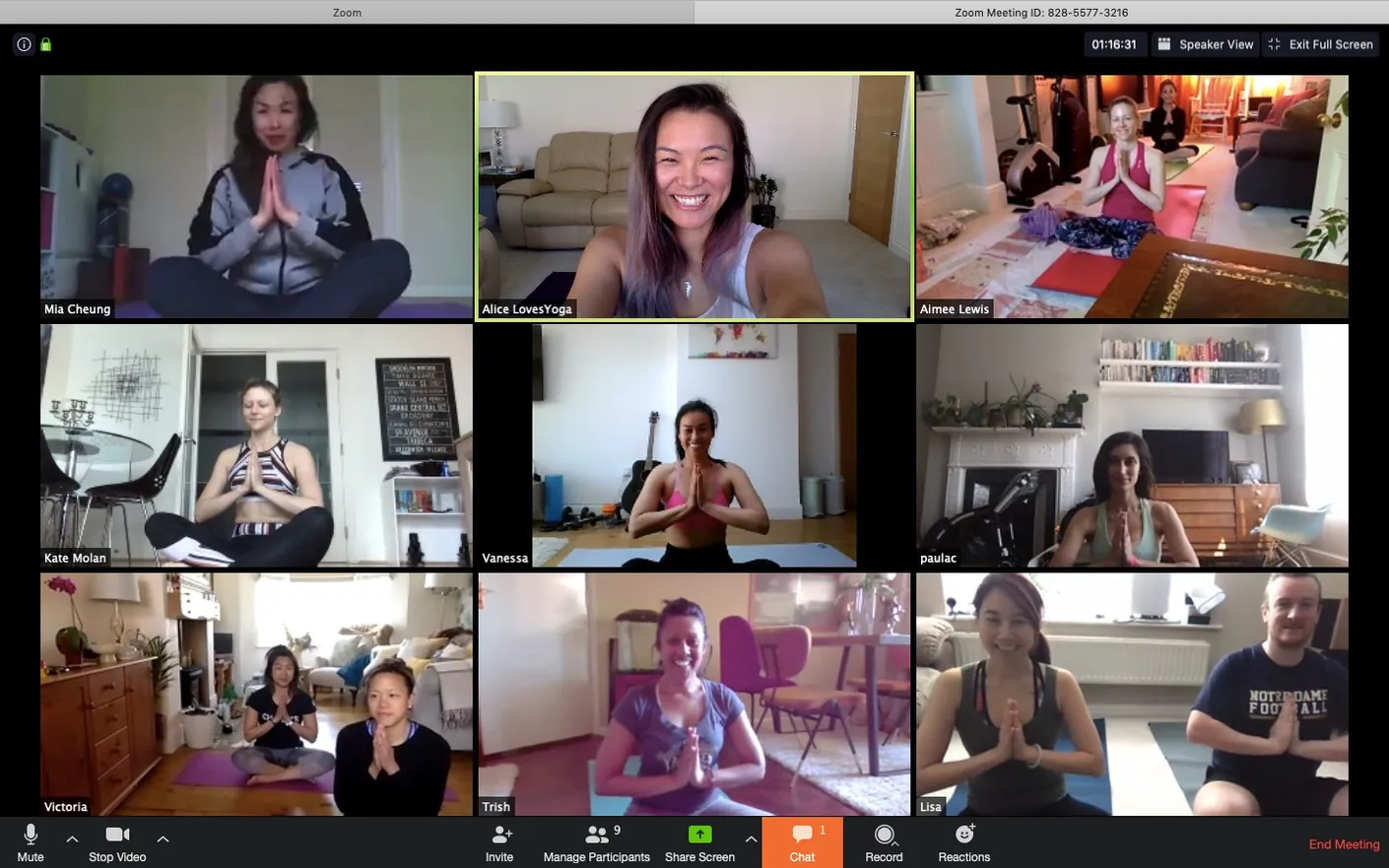
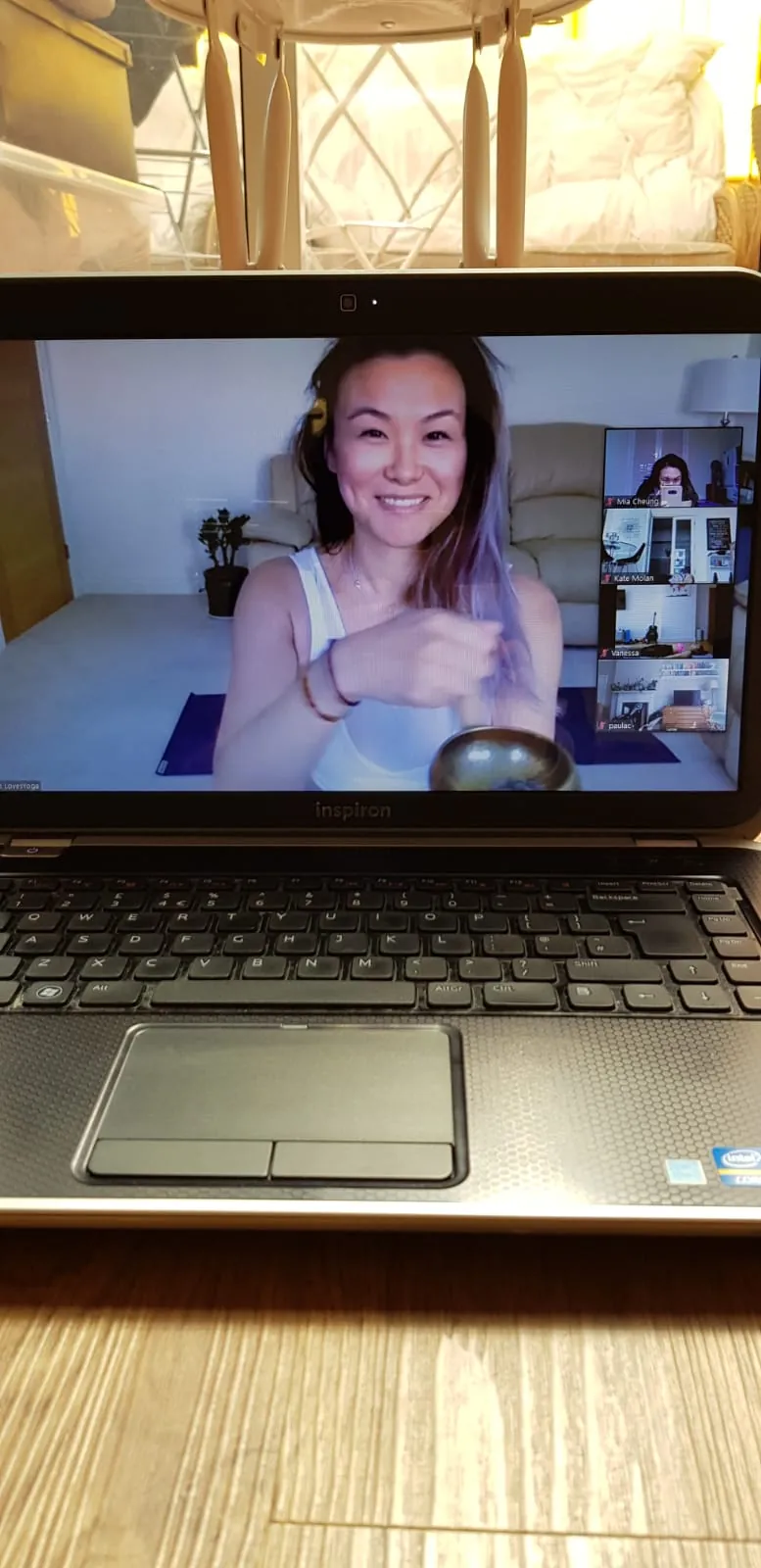
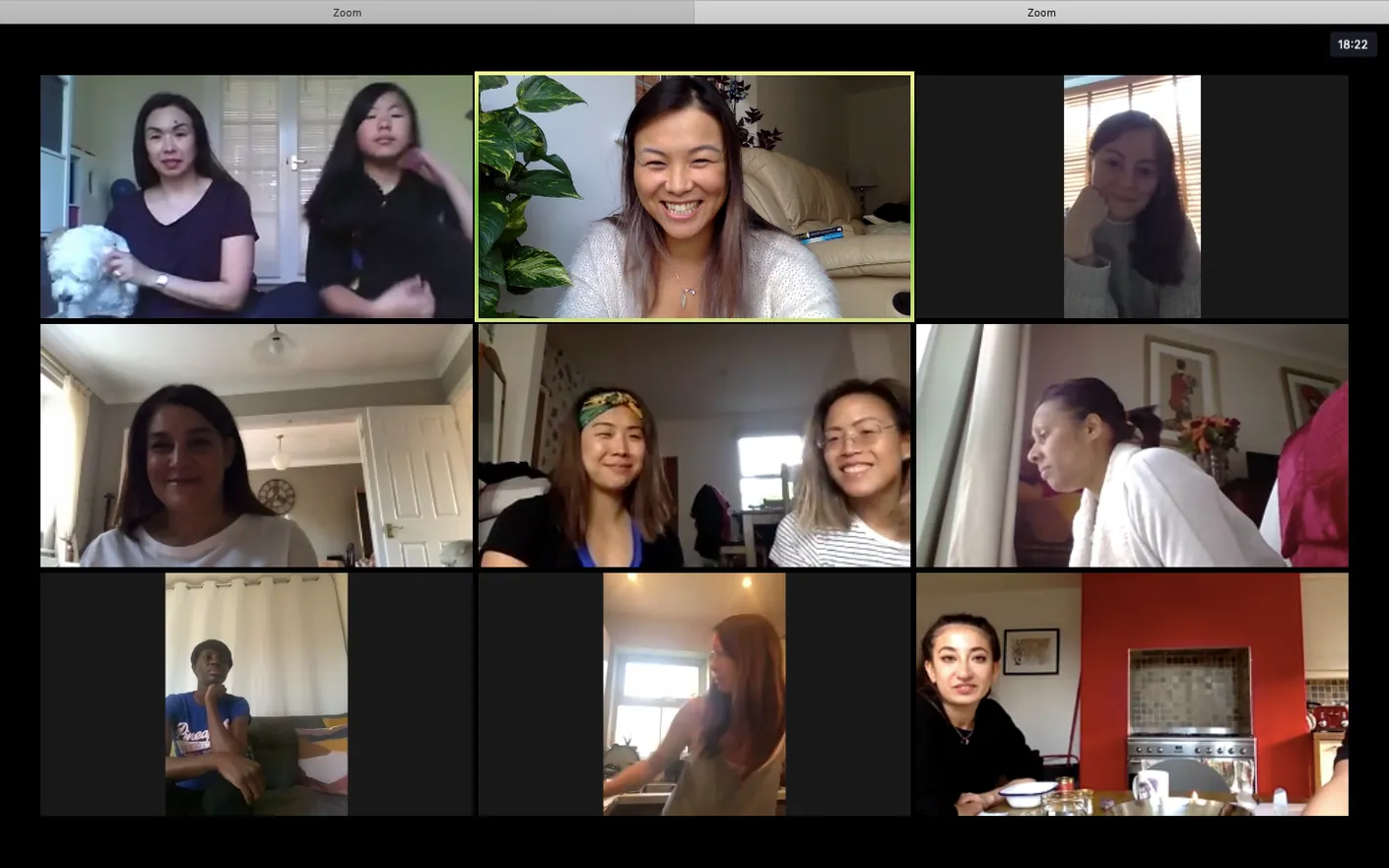
I did not know I was experiencing psychosis while I was inside it. I continued teaching yoga online through a mind I felt I was slowly losing.

My brain broke down in the space it needed. Then I began the slow work of rebuilding.

I eventually accepted something I had resisted: I was not going to get my old brain back exactly as it had been.

Acceptance was not resignation. It was the point from which I could finally work with reality.

Acceptance was easy once I saw my reality of never having my old brain ever again. I learned to improve what could be improved, and compensate for what had changed.

That period changed my relationship with strength. I became less interested in appearing strong and much more interested in what actually creates stability.

What stayed steady

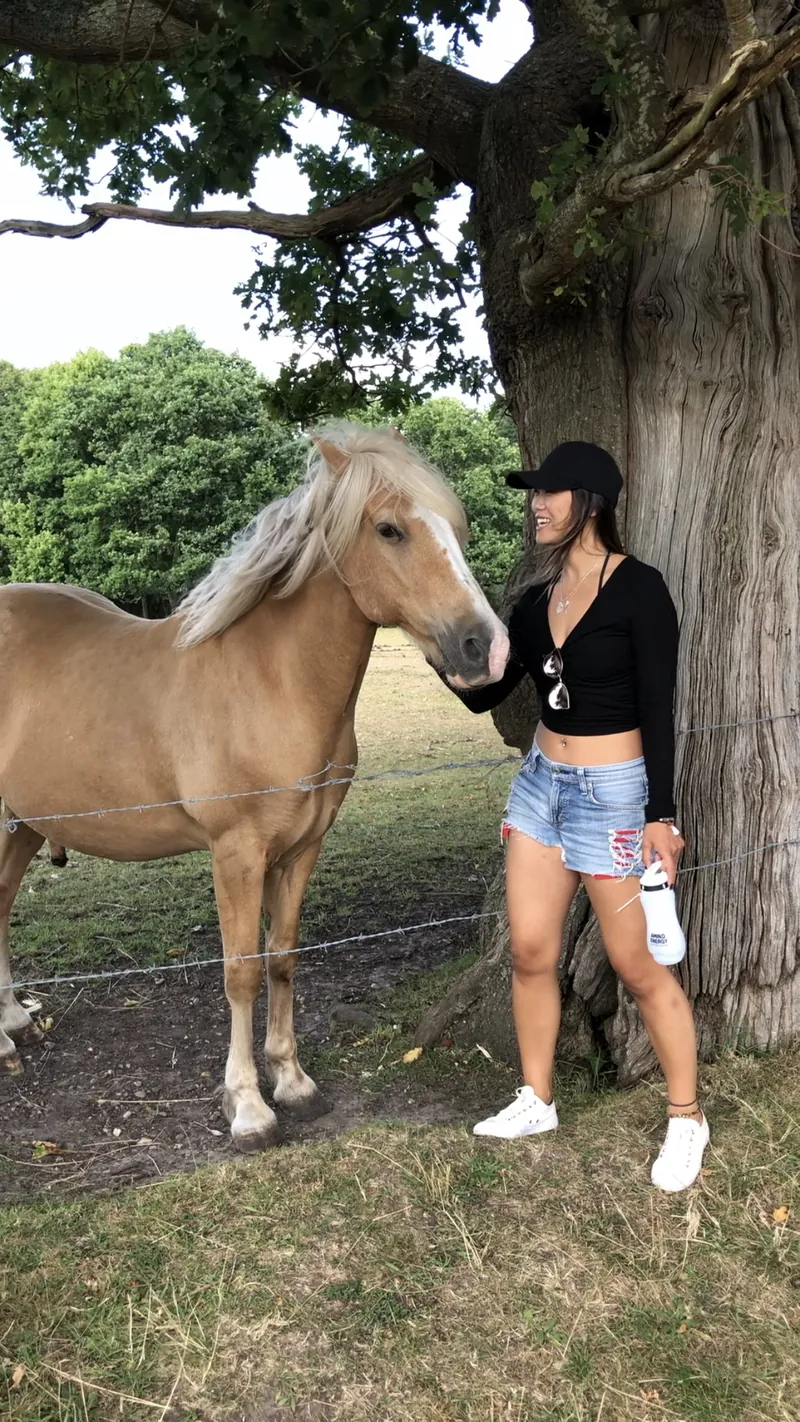
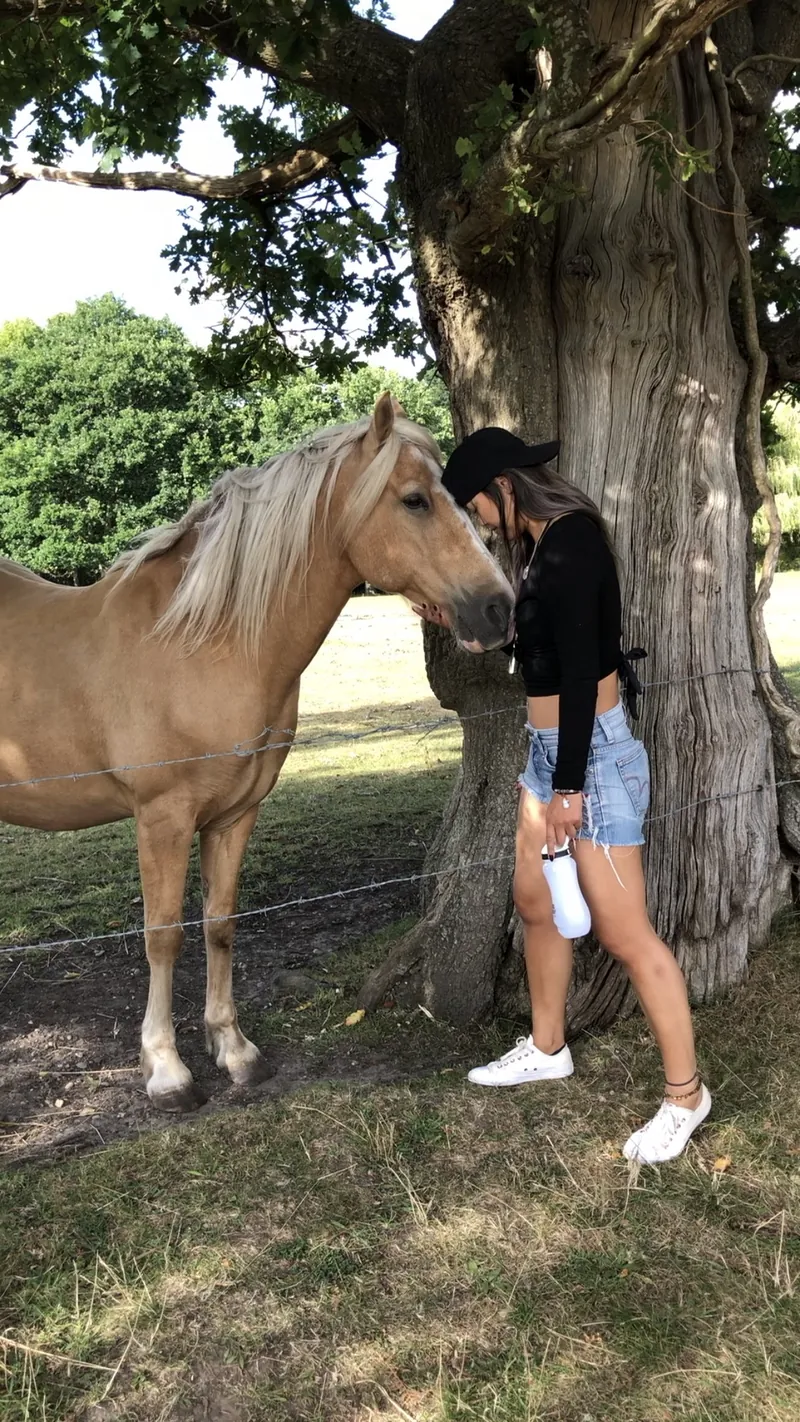
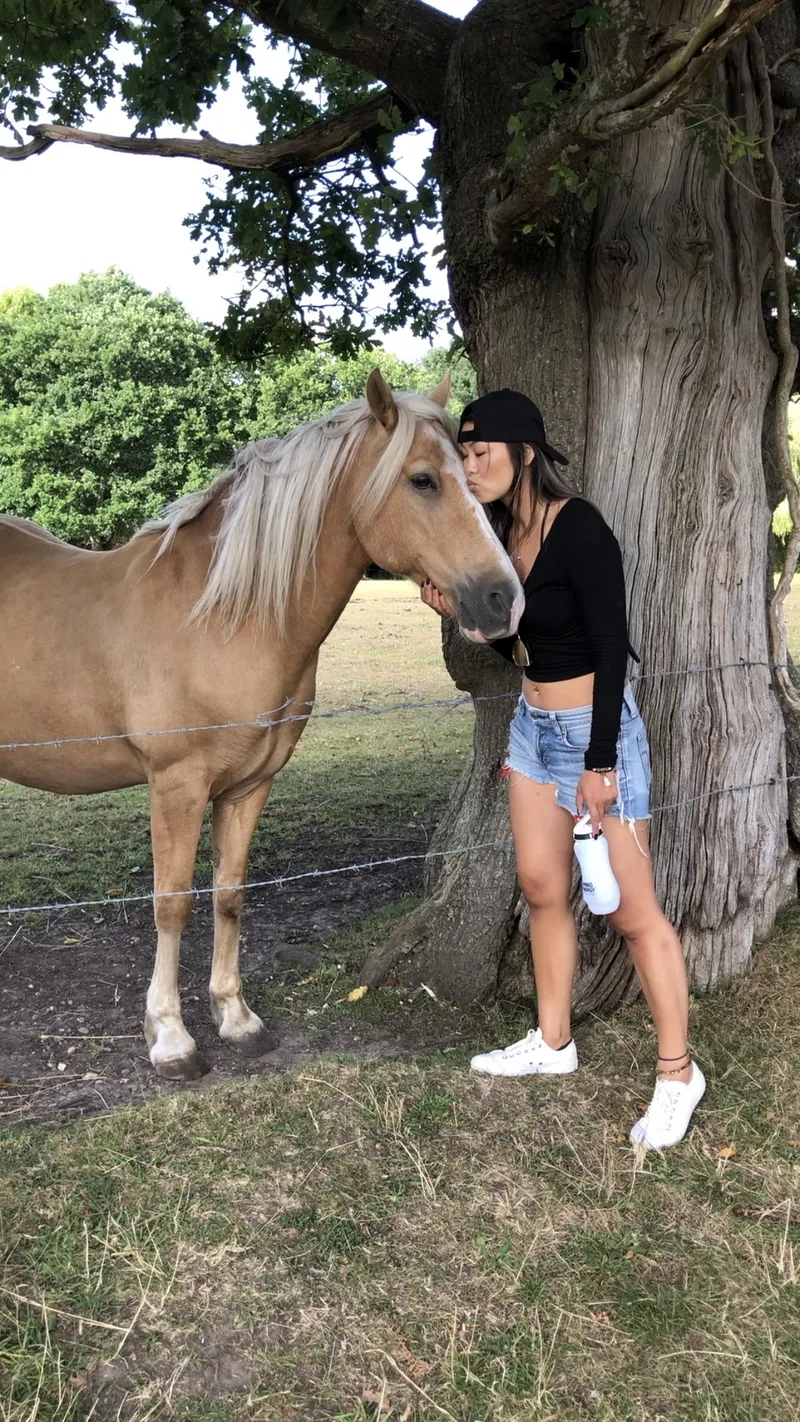
It was just Prince Charming and Alice.

When language and cognition could not hold everything, his presence gave me something steady.

A quiet relationship that asked nothing of me.

Alice standing beside Prince Charming beneath a large tree 01
Alice and Prince Charming touching foreheads beneath the tree 02

Press play · Alice with Prince Charming

Alice standing close to Prince Charming beneath the tree 03
Presence before language

He always came over when I arrived at his field.

Prince Charming

Teaching through lockdown

I kept teaching while rebuilding my own mind.

Yoga was the beginning of learning how the body works as a unit.

Speaking, moving, remembering and tracking a room at once became part of how I trained my brain back into coherence.

Alice Muse standing among pale flowers with one hand over her heart and one hand over her stomach
Surviving something dramatic did not resolve the quieter adaptations underneath.

The pattern beneath the performance

Relationships exposed what crisis had not.

Because I had never felt emotionally loved by my father, I had no reliable internal calibration for how love from a man should feel. I was not consciously choosing pain. I simply had blind spots around what was familiar.

A breakup took me into grief. Grief eventually took me into shame. And shame showed me the pattern.

I began to see the enmeshment, limerence, low self-worth and self-abandonment that had shaped parts of my relational life.

I studied attachment, trauma, psychology, the nervous system and relational patterns.

I learned boundaries as information rather than punishment. I learned that no does not require a prosecution case. I learned to recognise red flags without immediately explaining them away. I learned that understanding another person's wounds does not require giving them access to me.

By late 2025, chronic anxiety was no longer organising my life. I could feel emotions in real time without being consumed by them. My identity felt increasingly self-authored rather than built around who other people needed me to be.

My strength no longer required my disappearance.

Practice, training and integrity

Authority grounded in experience, observation and clear limits.

Somatic Pattern Recognition Practitioner

5Years working directly with clients.
2Years in rehabilitation clinics: as a yoga teacher in one and a somatic practitioner in another.
10Years teaching yoga.
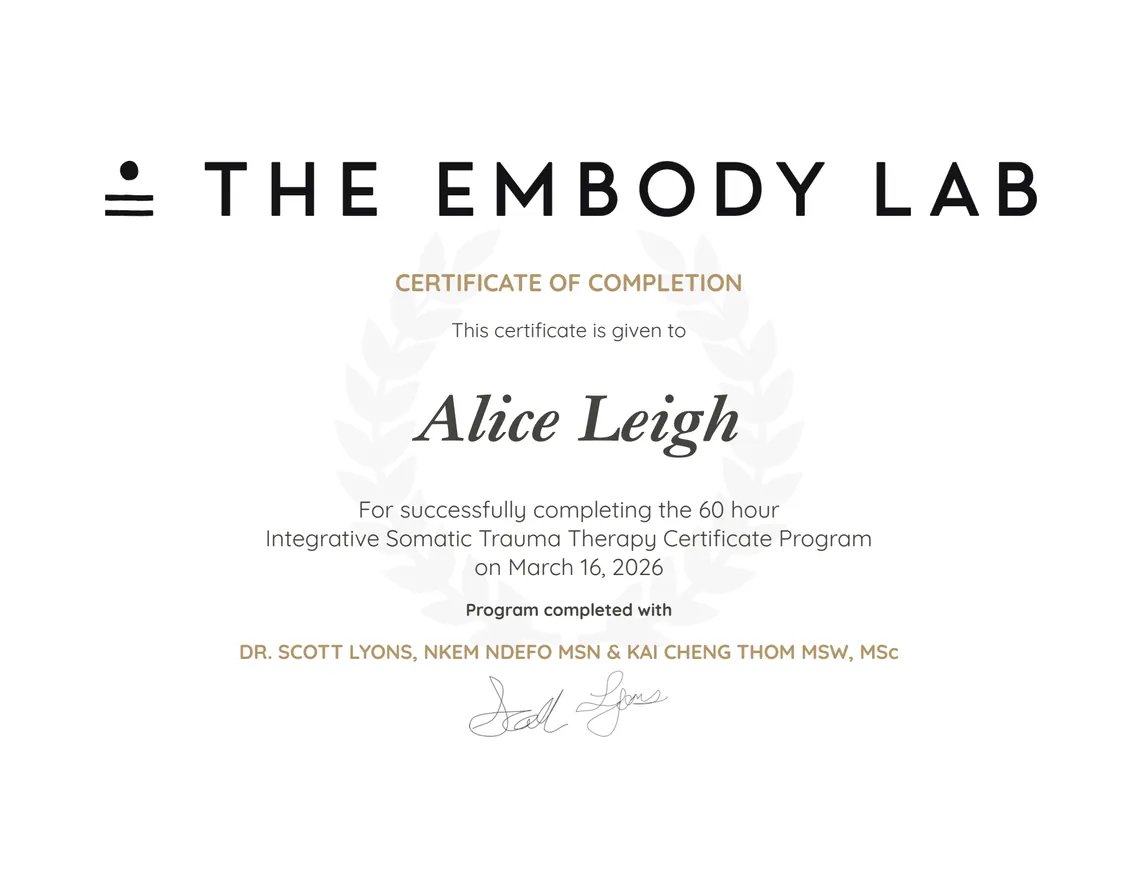
60Hour Integrative Somatic Trauma Therapy Certificate Program completed.
BBusiness degree.

My authority is grounded in lived experience, disciplined observation, direct client work and training. My integrity includes knowing where that authority ends.

Scope: I am not a licensed therapist, crisis service or medical provider. My work is somatic-based, trauma-informed and coaching and mentoring-led. I do not diagnose or treat mental illness. When a woman needs clinical or medical care, I recommend that she seek the appropriate professional support.

Private work is held with care, discretion and confidentiality.

Alice Muse smiling among pale flowering branches
Sovereign · Nurturing · Non-judgmental
Certificate of completion The Embody Lab certificate awarded to Alice Leigh for completing the 60 hour Integrative Somatic Trauma Therapy Certificate Program

Private Intensive

Bring the pattern you cannot solve with more thinking.

You do not need to arrive with the right language. You do not need to explain every year of your life before we can begin.

The Private Intensive is a focused 75-minute online session for women ready to look beneath the performance, identify the pattern and understand what is actually keeping it in place.

$500 · Private online session

Request a Private Intensive